
Are Your Walls Costing You Weeks? How AI-Driven Wall Framing Changes the Math

Are your walls quietly costing you weeks and burning through labor you don’t have to spare? In a market where schedules slip, trades stack up, and good crews are hard to find, onsite stick framed walls might be one of the biggest hidden drags on your jobs.
This is where AI-Driven wall framing steps in: not as another buzzword, but as a way to turn walls from a site-built variable into a predictable system that speeds up the whole build.

Are Your Walls Costing You Weeks?
Walk any jobsite in the US or Canada and the pattern is familiar: walls are still framed onsite by hand, often in harsh conditions, with constant coordination between carpenters and downstream trades. Every plan change, missed layout, or misaligned opening ripples through inspections, trades, and schedules.
Those walls cost you time because:
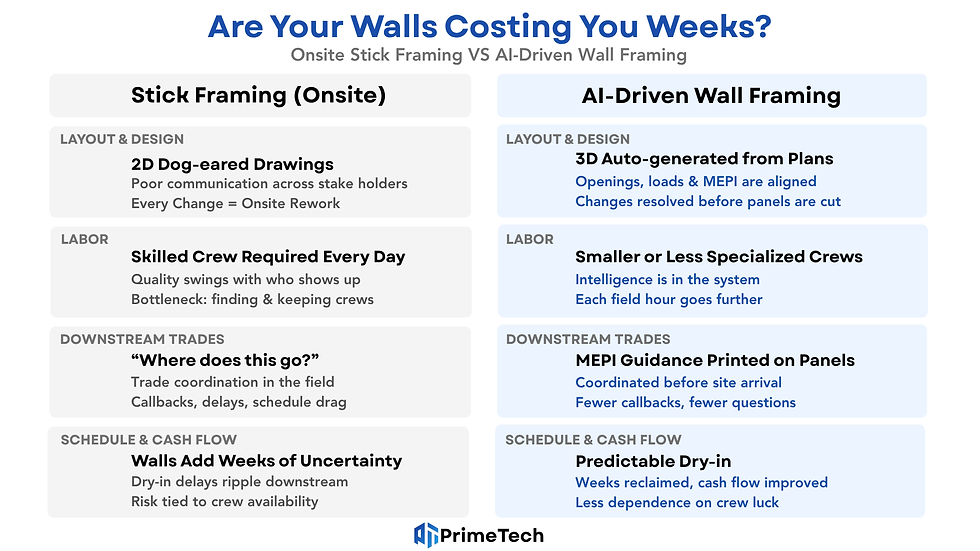
Layout lives in someone’s head or in dog-eared drawings.
Quality and speed swing widely based on the crew you can get that week.
Every change means rework, in the worst possible place: in the field, on the clock.
If walls are the operating system of the house, most projects are still running on analog.
What Is AI-Driven Wall Framing?
AI-Driven wall framing starts by treating walls as data and logic before they ever become material.
Instead of manually interpreting 2D plans and redlines, AI-Driven workflows:
Ingest the plans and automatically generate optimized wall layouts.
Coordinate openings, loads, and service pathways in a single digital environment.
Produce fabrication-ready instructions for offsite production.
That intelligence then flows straight into a smart wall system: panels that arrive pre-cut, pre-labeled, and pre-communicated, with color-coded printed on installation instructions that tells crews exactly what goes where.
The goal isn’t to replace the field crew. It’s to stop forcing them to solve design and coordination problems in real time.
How AI-Driven Wall Framing Changes the Labor Math
The biggest pressure point in residential construction today is labor: finding it, keeping it, and deploying it where it creates the most value.
AI-Driven wall framing changes that equation in a few key ways:
Less design drag. Automating a large chunk of the digital design and coordination work shrinks the front-end time from plan to production.
Fewer skilled hours on site. When walls arrive as a system instead of a pile of sticks, you can frame faster with smaller or less specialized crews.
Fewer surprises for trades. Printed-on-panel MEPI guidance and coordinated layouts mean fewer “where does this go?” questions and fewer callbacks.
Instead of throwing more labor at the wall, you embed intelligence into the system so that each hour in the field goes further.
From Onsite Stick Framing Chaos to Offsite Wall Systems
Offsite wall fabrication is not new. What’s new is making it flexible enough to plug into existing supply chains and local markets in the US and Canada.
AI-Driven wall framing pairs naturally with:
Distributed fabrication lines that can sit alongside existing truss and component plants.
Compact, automated equipment that doesn’t require mega-facilities or massive capital outlays.
Regionally tuned wall assemblies that reflect local codes, climate, and material availability.
Instead of sending every project through a distant factory, you enable a network of local or regional partners who can build the same smart wall system closer to where you build.
Why Builders and Manufacturers Should Care Now
If you are a builder or developer, weeks matter. Every day you shave off framing and dry-in moves cash flow, risk, and customer experience in the right direction. AI-driven wall framing is about:
Getting to dried-in faster and more predictably.
Reducing your dependence on the luck of which crew shows up.
Improving thermal and acoustic performance as a byproduct of a better wall system—not an extra layer of complexity.
If you are a truss or component manufacturer, this is a chance to move from commodity products to a higher-value wall system that slots into what you already do, rather than competing with it.
So... Are Your Walls Costing You Weeks?
If your walls are still entirely built onsite, they probably are. The question isn’t whether AI-Driven wall framing and offsite wall systems will change residential construction in the US and Canada, it’s who will benefit from that shift first.
Builders who adopt smarter walls early stand to gain time, predictability, and resilience in a labor market that doesn’t look likely to ease up. Manufacturers who plug into these systems can move up the value chain instead of racing to the bottom on price.
For more information on AI-Driven wall systems please contact info@primetech.build
Comments